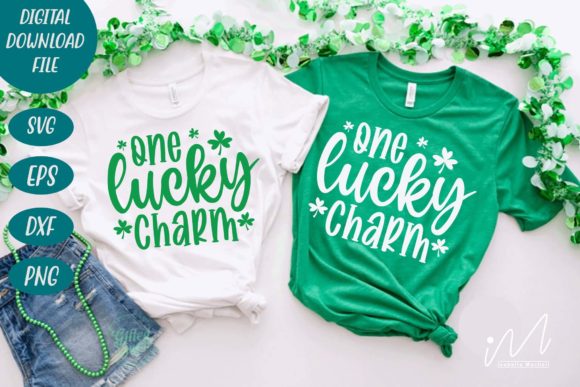
One Lucky Charm SVG: Graphics for Crafts & Local Branding
As a brand designer who’s developed visual identities for over two dozen local businesses—from artisanal candle studios in Asheville to family-run bakeries in Portland—I recently evaluated One Lucky Charm SVG for a real-world project: rebranding a small-batch herbal tea company launching its first line of seasonal gift boxes. My goal wasn’t just to see if it “looks nice”—it was to ask: Does this graphic design asset strengthen brand identity? Does it earn trust on a crowded shelf? Does it scale meaningfully across packaging, social media graphics, and printed collateral?
A Warm, Handmade Vibe—Not Just Decorative Clipart
At first glance, One Lucky Charm SVG delivers an immediate mood: gentle optimism with quiet confidence. It’s not flashy or loud—it leans into soft curves, balanced negative space, and subtle decorative detail that reads as handmade, approachable, and intentionally crafted. Think less “corporate mascot,” more “thoughtful talisman.” For local businesses rooted in authenticity—like a skincare brand using locally foraged botanicals or a children’s product line made by hand in a Brooklyn studio—this tone aligns naturally. It feels premium without being stiff, friendly without being cutesy, and organic without sacrificing clarity.
Where This SVG Design Earns Its Place in Real Business Use
In the tea brand project, we used One Lucky Charm SVG across six key touchpoints—and each time, it served a functional role, not just aesthetic flair:
- Product labels: Placed subtly beneath the flavor name on matte kraft tea tins, it added warmth and memorability without competing with legibility.
- Packaging accents: As a foil-stamped motif on the inside lid of gift boxes, it elevated perceived value and reinforced the “thoughtful gifting” message.
- Thank-you cards & hang tags: Sized down and paired with a warm serif font, it created emotional resonance—customers mentioned it unprompted in reviews.
- Social media graphics: Layered over lifestyle photography (steaming mugs, dried lavender bundles), it anchored seasonal campaign visuals with consistent visual hierarchy.
- Printable inserts: Included in digital download bundles as a PNG Trans file, it gave customers a branded, shareable element—boosting organic reach.
- Product mockups: Used in Shopify banners and Etsy listing previews, it helped convey brand personality before the customer even clicked “add to cart.”
How It Strengthens Small Business Branding—Beyond Aesthetics
This isn’t just another clipart download. When applied with intention, One Lucky Charm SVG supports tangible business outcomes:
- Stronger first impression: On a farmers’ market table or Instagram feed, it signals care and cohesion—not randomness.
- Better product recognition: Repeated use across labels, stickers, and bags builds subconscious familiarity.
- Clearer visual hierarchy: Its balanced weight and spacing make it ideal for supporting—not overwhelming—core messaging.
- More consistent brand identity: As a reusable SVG design, it scales flawlessly from ¼” sticker to 48” banner—no pixelation, no rework.
- Improved customer trust: Professional packaging design conveys credibility, especially for handmade business owners without in-house designers.
Best Fit: Where This Graphic Design Asset Shines
We found One Lucky Charm SVG most effective when used as a *supporting* brand element—not the hero logo, but the thoughtful accent that ties everything together. It excels in:
- Product labels and jar seals for food brands, apothecaries, and bath & body lines
- Packaging accents—especially on kraft paper, linen, or textured stock
- Hero graphics for holiday or seasonal campaigns (think “lucky new year,” “spring renewal,” “grateful harvest”)
- Decorative brand elements on business cards, thank-you notes, and email headers
- Social media campaign graphics where warmth and humanity matter more than sharp edges
- Printable design assets for customer-facing materials like recipe cards or care instructions
Use With Intention—Not Everywhere
Like any strong design asset, One Lucky Charm SVG has boundaries. We avoided it in contexts where clarity, minimalism, or legal precision took priority:
- Formal corporate branding systems (e.g., law firms or financial advisors)
- Very small labels where fine detail would blur at print size
- Crowded packaging layouts already dense with ingredients, certifications, or regulatory text
- Backgrounds with low contrast—test it against your actual label stock, not just white screens
- Luxury minimalist brands where restraint is the core message
- Any area where decoration competes with essential information (e.g., net weight, allergen statements)
Practical Brand Designer Notes Before You Implement
Before rolling One Lucky Charm SVG into client work or your own small business branding, run these checks:
- Test it on real packaging mockups—not just digital previews—to assess scale and proportion.
- Check black-and-white usage: does it retain shape and impact when printed in one color?
- Preview it at ⅜” height on a product label—does it read clearly?
- Test it with your full brand palette: does it harmonize with your primary and secondary colors?
- Compare it visually with top three local competitors’ packaging—is it distinct yet category-appropriate?
- Review PNG transparency: does the edge render cleanly on colored backgrounds?
- Inspect SVG editability: can you isolate and recolor individual elements in Illustrator or Affinity Designer?
- Test it beside your chosen fonts—serif, sans serif, script, handwritten, and display—to ensure typographic harmony.
- Confirm commercial license terms: this is essential for physical product sales, client deliverables, and marketing visuals.
For local business owners, handmade sellers, and creative entrepreneurs building real brands—not just digital products—One Lucky Charm SVG isn’t filler. It’s a versatile, emotionally intelligent graphic design asset that, when applied with strategy, elevates packaging design, strengthens product label storytelling, and adds quiet professionalism to every customer touchpoint. In a marketplace saturated with generic clipart, it’s the kind of thoughtful detail that makes your brand feel human—and memorable.